

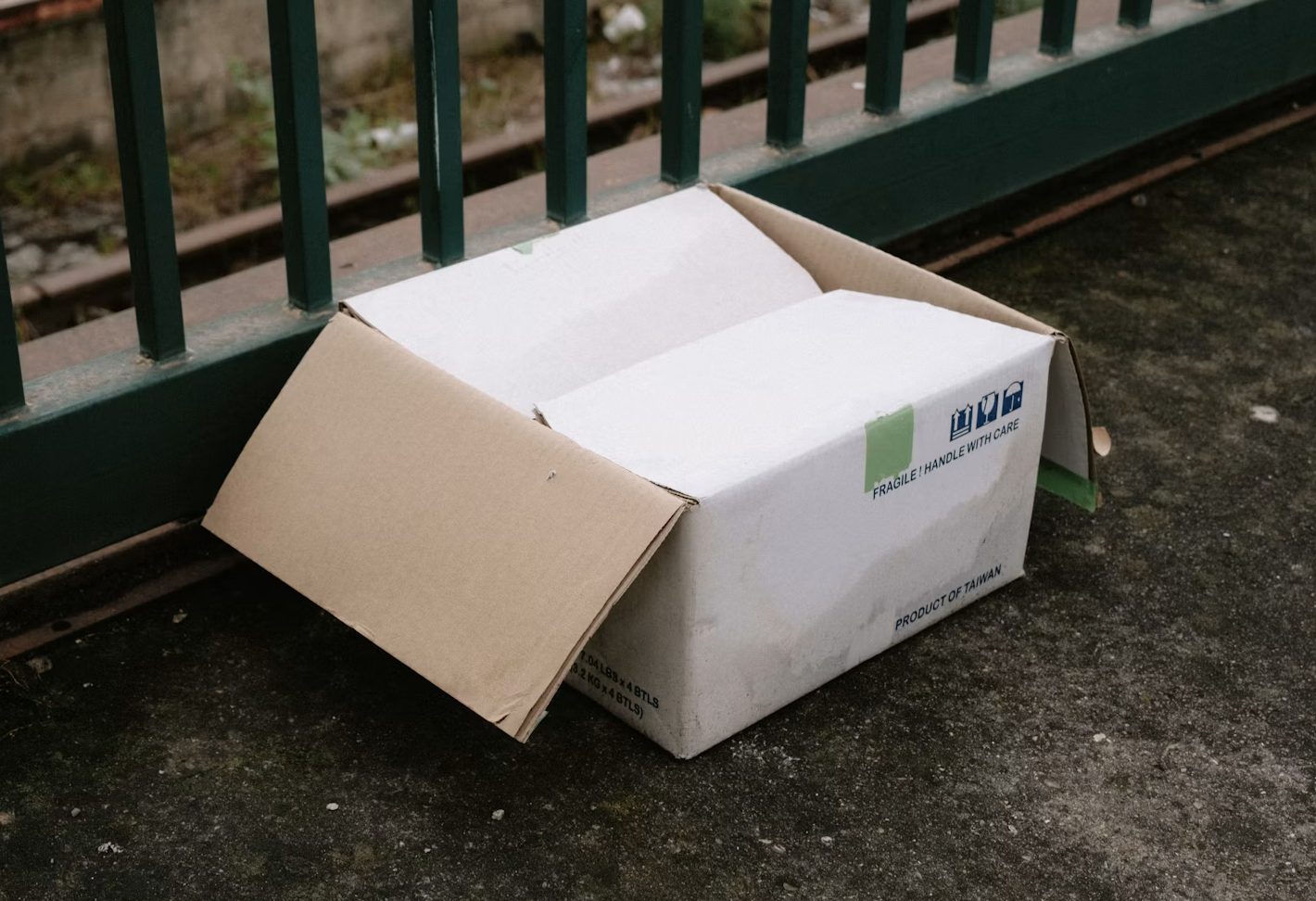
A damaged box that arrives back at your facility is not a failure. It is a message. The pattern of the damage describes exactly what happened to it during transit. Once you know how to read that pattern, you know what to change so it does not happen again.
Most businesses throw the damaged box away and order another shipment in the same packaging. This solves nothing. The next shipment fails the same way.
This guide teaches you to read the damage.
Why Reading Damage Patterns Matters
The distribution environment subjects packages to four types of force: compression (stacking weight), vibration (movement during transport), impact (drops and collisions), and moisture (humidity and water exposure).
Each type of force leaves a specific pattern. The pattern tells you which force caused the failure and where in the shipping chain it happened.
Diagnosing the cause before changing the packaging prevents the common mistake of solving the wrong problem. A box with corner failures does not have the same problem as a box with side wall collapse. Fixing one does not fix the other.
CIP Packaging uses this type of failure analysis when working as a Packaging Corporation Denver CO. Reviewing the damaged package, the product, and the distribution conditions helps connect the visible failure to the force that caused it. The packaging specification can then be changed for the actual failure mode rather than for the symptom alone.
Corner Failures: What They Mean
What it looks like: The corners of the box are crushed or punctured. The face panels are intact but the corners are damaged.
What caused it: Impact. The box was dropped or thrown onto a corner or edge.
Corners are the structural junction point of a box. When a box lands on a corner, the impact energy concentrates at that point rather than distributing across a face. The corner absorbs all the energy and fails first.
Corner failures are most common in:
- Parcel carrier handling (packages sorted through automated systems that drop and redirect)
- Last-mile delivery where packages are tossed from delivery vehicles
- Warehouse conditions where boxes are handled quickly
What changes:
Box wall specification: A heavier-wall corrugated does not necessarily prevent corner impact failure. The corner fails because of concentrated force, not because the walls are weak.
Corner protection: Foam corner inserts, molded pulp corner pads, or thick cardboard angle boards placed inside the box at each corner distribute the impact force from the corner to the face panels, which are much better at absorbing it.
Inner packing: A product that has cushioning keeping it away from the box wall is isolated from the corner impact. A product sitting directly against the box wall transfers the corner impact directly to the product.
Top Crush Failures: What They Mean
What it looks like: The top of the box is crushed downward. The bottom and sides are intact. The box looks like something heavy sat on top of it.
What caused it: Stacking overload. The boxes above this one exceeded the box’s rated stacking strength.
What caused it specifically:
Corrugated boards lose compression strength in humid conditions. A box rated for 65 pounds of stacking load at 50 percent relative humidity performs at approximately 52 pounds at 70 percent humidity and at approximately 40 pounds at 90 percent humidity. The compression strength ratings on box specifications are measured under standard laboratory conditions, not warehouse or transit conditions.
If your boxes are being shipped through Southern states in summer or stored in a non-climate-controlled warehouse in July, the rated stacking strength is not the actual stacking strength in those conditions.
What changes:
Higher ECT rating: Moving from 32 ECT to 44 ECT increases the box’s resistance to top compression under load.
Moisture resistance: Wax-coated board or water-resistant corrugated treatments maintain a higher percentage of rated compression strength in humid conditions. This is the correct solution when the failure is clearly humidity-related.
Stack height limit: Some products cannot be packaged to survive arbitrary stack heights. Communicating maximum stack height to carriers through handling labels and pallet configuration limits is a logistics solution rather than a packaging solution.
Side Wall Failures: What They Mean
What it looks like: One or more face panels have bowed outward or inward. The box has lost its rectangular geometry. The corners at the affected panel may have split.
What caused it: Horizontal pressure, the box was squeezed from the sides rather than crushed from the top.
This happens when a box is between two heavier objects in a vehicle or container that shifted during transit. The contents of the vehicle press against the box from the side rather than from above.
It also happens when boxes are packed too tightly in a shipping container or truck and the arrangement creates lateral load where none was anticipated.
What changes:
Rigid interior structure: A product that fills the box to its walls provides side wall support that an empty box does not. The product itself becomes a structural member. If the product is small relative to the box, it does not provide this support.
Double-wall corrugated: Double-wall board provides significantly more resistance to lateral compression than single-wall. This is the correct specification change when the failure mode is clearly side wall compression.
Better packing pattern: Sometimes the problem is in how boxes are arranged in the vehicle or container, not in the box itself. A load that is arranged so boxes never face lateral load from the vehicle contents eliminates this failure mode without any packaging change.
Moisture Failures: What They Mean
What it looks like: The box is soft, floppy, or stained. The board has delaminated, the layers of the corrugated wall have separated. The print may have run or smeared. The product inside may show moisture damage.
What caused it: Water exposure or high humidity over an extended period.
Corrugated board is a paper product. It absorbs moisture readily. Extended exposure to rain, sprinkler overspray, snow, or sustained high humidity degrades the board’s structural properties rapidly.
Where in the supply chain it happened:
Moisture damage has specific visual indicators of timing:
- Moisture damage from a single event (a rain shower during outdoor staging) typically affects one side or the bottom of the box and shows a relatively clean water line where dry meets wet
- Moisture damage from extended humidity exposure affects the entire box evenly and is often accompanied by mold growth inside the box
- Moisture damage from condensation (temperature change between cold storage and warm air) appears as a general softening without a clear water line
What changes:
Moisture-resistant treatment: Wax-coated board, water-resistant edge sealer, or fully coated board increases moisture resistance significantly. These treatments add cost but are the correct specification for products stored or shipped in high-humidity environments.
Barrier packaging inside: A poly bag or moisture barrier bag around the product inside the box protects the product even when the box itself is compromised by moisture. The box handles the structural function. The inner bag handles the moisture barrier function. This separation of duties produces better outcomes than trying to make one material do both jobs.
Transit route awareness: Products shipped through the Gulf Coast, Southeast, or Hawaii face meaningfully different humidity conditions than products shipped through Colorado. Packaging specified for Colorado’s dry climate is often underspecified for coastal markets.
Print Failures: What They Mean
What it looks like: Print that looked correct on the proof has shifted, smeared, or shows color register problems on the actual boxes.
What caused it: This is not a transit damage problem. This is a production quality problem that happened before the box left the supplier.
Color register failure (one color shifted relative to another, producing a shadow or halo effect around text) is caused by plate mounting problems or press calibration issues at the printing facility.
Color inaccuracy (the red is more orange than the approved reference) is caused by ink mixing variation or by printing on board stock with a different surface brightness than the approved sample.
Smearing is caused by insufficient cure time between the print and the next handling step, or by high humidity during curing.
What changes:
None of these problems are solved by changing the box specification. They are solved by conversations with the supplier.
Ask the supplier for:
- A production sample from the actual press run (not a proof from a different print system)
- Their registration tolerance specification (how much shift is considered acceptable)
- Their quality inspection protocol for color accuracy
A supplier who cannot answer these questions does not have a defined quality system. A supplier who can answer all three and provides production samples for review before full run acceptance has the process controls that prevent these failures.
The Complete Diagnostic Checklist
When a damaged package returns, work through these questions in order.
1. Where is the damage located?
Corners → Impact damage
Top surface → Compression / stack overload
Side walls → Lateral squeeze
All surfaces uniformly → Moisture / humidity
Print only → Production quality issue
2. How many packages from the same shipment were damaged?
One or two damaged packages in a shipment of 200 → Isolated handling incident, likely not a packaging problem
More than 5 percent of a shipment → Systematic problem with the transit route, the carrier, or the packaging specification
3. Does the damage pattern repeat across multiple shipments?
A pattern that appears in multiple shipments consistently → Systematic cause that the packaging specification needs to address
Damage that appears in one shipment and not others → Isolated event, monitor before changing specifications
4. What is the carrier and transit route?
Different carriers have different handling profiles. Parcel carriers with automated sorting systems subject packages to more drop events than freight carriers with hand-loaded pallets. Knowing which carrier produced the failure helps determine whether the solution is in the packaging or in the carrier selection.
5. Was the damaged box the correct specification for the product and route?
Many damage failures are not failures of the specification. They are evidence that the wrong specification was used for the actual transit conditions. A 32 ECT box designed for light-duty e-commerce handled through a freight carrier’s heavy-duty industrial system was simply underspecified for the environment it was used in.
What to Do With the Damaged Box Before Throwing It Away
Before discarding a damaged package, photograph it from six angles:
- All four face panels
- Top
- Bottom
Note the carrier, the transit route, the date, and the sequence number in the shipment. Write this on a piece of paper and photograph it with the box.
This documentation is the evidence base for a conversation with your supplier. A supplier who receives photographs of damaged products and a description of the transit route can assess whether the specification was appropriate or needs adjustment. A supplier who receives the description “some boxes got damaged” can only offer general advice.
The photograph series takes four minutes. It turns a loss into information.
Key Takeaways
- Corner damage indicates impact, the box was dropped or thrown onto its corner. Foam corner inserts are the correct solution, not heavier board
- Top crush indicates stacking overload. Corrugated compression strength drops significantly in humid conditions relative to laboratory ratings
- Side wall failure indicates lateral compression from adjacent cargo in transit. Double-wall board or better load arrangement addresses it
- Moisture damage that is uniform across the box indicates extended humidity exposure. Moisture damage with a waterline indicates a single event
- Print failures are production quality problems, not packaging specification problems. Ask for production samples from the actual press run
- Photograph damaged packages from six angles before discarding. This creates the evidence base for a productive supplier conversation