
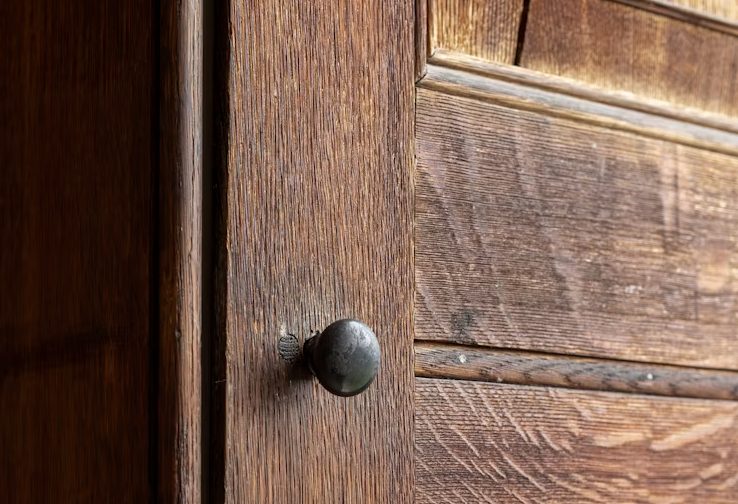
Wood is a biological material. This is the fact that makes it beautiful and the fact that it requires more careful management in Denver’s climate than in most of the environments where it is used. A door made from teak, mahogany, or Douglas fir is not an inert object installed in a frame. It is a living material’s dried remains, still responding to its environment through a cellular structure that absorbs and releases moisture, expands and contracts across temperature differentials, and degrades under UV radiation at a rate determined by the altitude of the location where it stands.
Because wood responds to moisture, temperature, and sunlight, the species, finish, and installation method all affect how well a wood door performs in Denver. Choosing the right combination can help reduce moisture absorption, movement, UV damage, and premature deterioration. For homeowners considering custom wood door Denver CO, these factors are important when selecting a door that can withstand the local climate over time.
What Denver’s Humidity Differential Does to Wood Dimensionally
Wood movement is not a defect. It is the expected behavior of a material whose cell walls contain hydroxyl groups that bond with water molecules. As ambient humidity rises, wood absorbs moisture and expands. As humidity drops, wood releases moisture and contracts. The degree of movement per unit of moisture change depends on the species and the grain orientation.
Denver’s relative humidity ranges from winter lows of 10 to 20 percent during dry cold spells to summer highs of 60 to 75 percent during monsoon events. This is a humidity swing of 40 to 60 percentage points across a single year, one of the widest annual humidity amplitude ranges of any major U.S. metropolitan area.
For a 36-inch-wide door panel in flat-sawn Douglas fir, this humidity swing produces dimensional movement of approximately 0.75 to 1.5 percent of width across the tangential grain direction. On a 36-inch panel, that is 0.27 to 0.54 inches of total movement across the year.
This movement must be accommodated in the door’s design and installation. Panel-and-frame construction, where a floating panel sits inside a grouted frame that allows independent movement, has handled this requirement for centuries. Solid slab doors without adequate panel freedom bind in their frames during wet season expansion and gap visibly during dry season contraction.
The finish system applied to all six faces of the door, including the top and bottom edges that most installations leave bare, is the moisture barrier that moderates the rate of moisture exchange and prevents the extreme end of the movement range. A door with unsealed top and bottom edges experiences moisture exchange at the end grain (the most permeable surface) at rates that produce cupping and warping as the edges move faster than the face.
What 300 Days of Sunshine and 5,280 Feet of Altitude Does to Wood Finish
Denver receives approximately 300 days of sunshine per year. At 5,280 feet, the atmospheric column filtering UV radiation is approximately 20 percent thinner than at sea level, producing 20 to 25 percent more UV intensity at grade than coastal cities at equivalent latitude.
UV radiation breaks down the polymer binder in wood finish through a process called photolysis, the light-driven breaking of chemical bonds in the binder that holds the finish together. As the binder degrades, the finish loses adhesion, chalks as pigment separates from the weakened matrix, and eventually cracks as the film becomes brittle.
A high-quality exterior wood finish rated for eight to ten years of durability at ASTM D1006 standard test conditions will perform to five to seven years on a south-facing Denver entry door exposed to direct afternoon sun, because the test conditions do not replicate Denver’s UV intensity or the thermal stress that rapid temperature changes in Colorado’s climate produce.
The correct specification for a Denver wood door finish includes:
- A penetrating oil base coat that seals the wood cellular structure before any film-forming product is applied
- A UV-stabilized film-forming topcoat with HALS (Hindered Amine Light Stabilizer) chemistry, which interrupts the photolysis chain reaction at the polymer level rather than merely blocking UV at the surface
- A maintenance schedule of two to four years for recoating on south and west-facing exposures rather than the generic eight to ten-year schedule that finish manufacturers publish for average conditions
What Wood Species Selection Changes About Long-Term Performance
Not all wood responds equally to Denver’s humidity cycling. The species selection for a custom wood door is a durability decision before it is an aesthetic one.
Teak: Native to tropical monsoon climates with wide wet-dry seasonal variation. The cellular structure contains natural silicates and oils that resist moisture exchange, reducing dimensional movement per unit humidity change. Janka hardness of 1,070 pounds-force. Excellent durability in exterior exposure. Surface oils require periodic renewal to maintain the protective function.
Mahogany (Honduran/genuine): Moderate dimensional movement. Fine, even grain that machines cleanly and holds finish well. Natural durability rating of Class 2 per EN 350-2 standards (durable). More affordable than teak with comparable outdoor performance when properly finished.
Douglas Fir: The most commonly used species in Pacific Northwest custom door production. Good strength-to-weight ratio, excellent dimensional stability for a softwood, and holds finish well when properly sealed. Less naturally durable than teak or mahogany (Class 3-4 per EN 350-2, moderately durable). Requires complete six-face sealing at installation.
White Oak: Tyloses in the vessel cells block moisture penetration in a way that red oak’s open vessel structure does not. This tylosis feature makes white oak considerably more water-resistant than red oak and more dimensionally stable in high-humidity-swing environments. Janka hardness of 1,360 pounds-force. Excellent choice for Denver’s humidity cycling.
Key Takeaways
- Denver’s annual humidity swing of 40 to 60 percentage points produces 0.27 to 0.54 inches of dimensional movement in a 36-inch Douglas fir door panel across the year
- Unsealed top and bottom door edges allow moisture exchange at the most permeable end grain surface, producing cupping and warping as edge sections move faster than face sections
- Denver’s 5,280-foot altitude produces 20 to 25 percent more UV intensity than sea-level locations, reducing exterior wood finish service life to 5 to 7 years on south-facing exposures versus 8 to 10 years at rated test conditions
- HALS chemistry in UV-stabilized topcoats interrupts photolysis at the polymer level rather than only blocking UV at the surface, the relevant specification difference for Denver’s high-UV environment
- White oak’s tylosis feature blocks moisture penetration through vessel cells in a way that red oak does not, making it more dimensionally stable than red oak in Denver’s humidity-cycling climate
Wood is the right material for a door that is meant to last decades and improve with age. Denver is the right climate for wood when the species, finish specification, installation detail, and maintenance schedule are calibrated to what Denver actually is.





1 thought on “What Denver’s Climate Extracts From Wood Over Twenty Years”