Kids who learn why recycling matters don’t just sort better at home — they become the household’s waste conscience. They ask uncomfortable questions at the dinner table. They notice what goes in the wrong bin at school. They remember.
That’s the real goal of bringing interactive recycling education into local classrooms.
Why Schools Are the Right Place to Start
Habits formed in childhood are remarkably durable. Recycling behavior is no different — children who learn correct sorting and waste reduction practices early carry those habits into adulthood, and into their own households.
But the opportunity goes beyond individual habit formation. Classrooms are community multipliers. One well-taught student reaches two parents, siblings, and often grandparents. Environmental education in schools doesn’t stay in schools.
What Interactive Actually Means
Traditional recycling education meant a worksheet and a poster. Interactive curricula means something fundamentally different.
Hands-On Sorting Stations
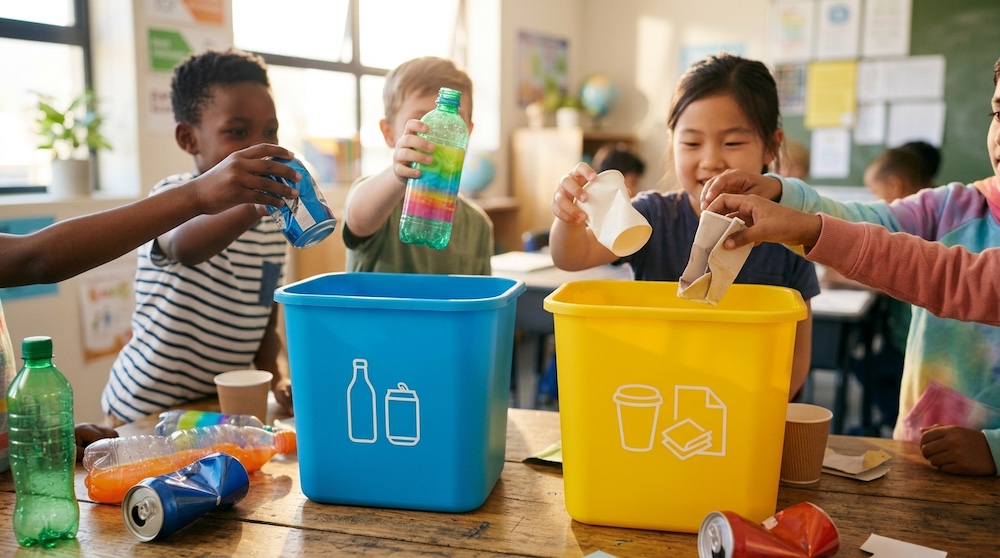
Students work with real materials — clean food packaging, paper products, glass, and compostable items — and physically sort them into the correct bins. The tactile experience of handling materials and making the sorting decision is retained far longer than any diagram.
Sorting challenges are introduced progressively:
- Basic separation of recyclables from landfill waste
- Distinguishing compostables from recyclables
- Identifying contamination and understanding why it matters
The Contamination Experiment
One of the most effective classroom activities demonstrates what happens when a single contaminated item ruins a recycling batch. Students see — visibly and concretely — how one greasy pizza box or food-soiled container affects an entire load.
The lesson lands differently when it’s demonstrated rather than described.
School Waste Audits
Older students conduct actual audits of their school’s waste bins — categorizing and weighing what’s being thrown away versus what should be diverted. The results often surprise them.
Finding that their own cafeteria is sending significant recyclable and compostable material to the landfill creates a sense of local ownership and urgency that no hypothetical scenario can replicate.
How the Curriculum Is Structured Across Grade Levels
Early Elementary (K–2)
Focus on the basics — what goes in which bin, why we separate materials, and what recycling actually means for the community. Visual learning tools, color-coded bins, and simple sorting games make concepts accessible.
Upper Elementary (3–5)
Introduction to the waste hierarchy — reduce, reuse, recycle — in order of priority. Students explore why reducing consumption matters more than recycling, and begin connecting their choices to broader environmental outcomes.
Middle School (6–8)
Systems thinking enters the picture. Students trace the lifecycle of common materials, explore what happens at recycling facilities and composting operations, and examine local municipal waste data.
At this level, the curriculum connects individual action to community-scale impact.
Getting Schools and Teachers On Board
The most effective rollouts treat teachers as partners, not just delivery vehicles. That means:
- Curriculum aligned to existing state science and environmental literacy standards
- Pre-built lesson plans that require minimal preparation time
- Take-home materials that extend learning into households
- Optional site visits to local recycling or composting facilities
Teachers who find the curriculum genuinely useful teach it with genuine enthusiasm. That enthusiasm is contagious in a classroom.
The Compounding Return
A single interactive recycling lesson reaches thirty students. Thirty students reach sixty or more parents. Multiply that across a district and across years, and the behavioral shift at the community level becomes measurable.
The next generation doesn’t need to be convinced that the environment matters. They already believe it. They just need the knowledge and tools to act on it.
That’s what good curricula delivers.