
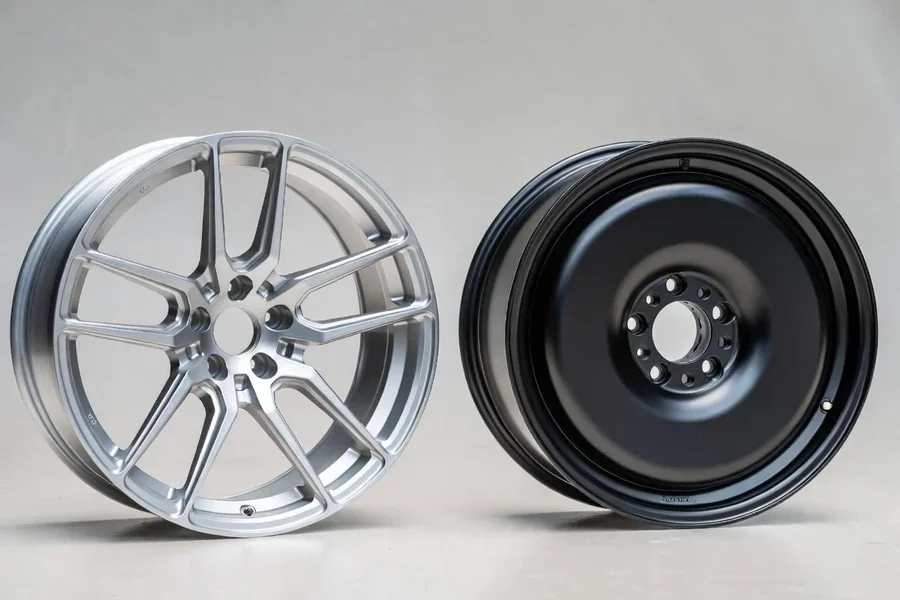
The usual version of this comparison says forged is stronger and lighter, cast is cheaper, and leaves you to conclude that spending more buys safety. That conclusion is wrong, and it matters. Aftermarket wheels sold for highway use are tested against the same performance standard whatever the process, so a cast wheel from a reputable brand is not a compromise on whether it holds. The premium buys something more specific.
This guide covers:
- How the three common constructions actually differ at the metal level
- What the price difference genuinely buys, and why weight matters twice
- How each type behaves when it finally does fail
- Which construction suits which driver, including the one most people skip
At a Glance
| Takeaway | Detail |
| The standard is the floor | Aftermarket wheels are tested to the same requirements whatever the process |
| Grain structure is the difference | Casting leaves a random structure, forging aligns and compresses it |
| Weight counts twice | Wheel mass is both unsprung and rotating, so reducing it has double effect |
| Failure mode differs | Cast tends to crack under impact, forged tends to deform |
| Flow formed is the middle | Cast center, spun barrel, much of the benefit at a fraction of the cost |
| Repairability follows the metal | A bent forged wheel can often be saved, a cracked cast one should not be |
Three Ways to Make a Wheel
Casting is the oldest and cheapest method. Molten aluminum is poured or drawn into a mold under gravity or low pressure and left to solidify. The result is accurate and inexpensive, and because the metal cools without being worked, the grain structure is random and contains some porosity. To reach a given strength, a cast wheel needs more material.
Forging starts from the opposite end. A solid billet of aluminum alloy is compressed under enormous pressure, aligning the grain along the lines of stress and eliminating the porosity casting leaves. The blank is then machined to shape, removing a lot of material. Denser metal means less of it is needed, which is where the weight saving comes from.
Flow forming sits between the two and deserves more attention than it gets. The center is cast conventionally, then the barrel is spun at speed while rollers stretch and compress it under heat. The barrel ends up with a worked grain structure closer to forged while the center stays cast. Since the barrel holds most of the rotating mass, that captures a real share of the benefit.
The cost ladder follows the effort. Casting is fast and needs little machining. Flow forming adds a step. Forging needs heavy equipment, a slower cycle, and extensive machining on a billet larger than the finished wheel.
What the Money Actually Buys
Weight, mostly. And wheel weight is worth more than an equivalent saving elsewhere on the car for two separate reasons that happen to stack.
The first is unsprung mass. A wheel sits below the springs, so the suspension controls its movement directly over every bump. Less mass there means the damper fights less inertia and the tire spends more time in contact with the road. That improves ride and grip together, which is unusual, since most changes trade one for the other.
The second is rotational inertia. A wheel does not merely travel forward, it also has to be spun up to speed. Energy goes into both, so mass at the rim is paid for twice under acceleration and again under braking. That is why the difference feels larger from the driver’s seat than the scale suggests.
The gap widens as diameter grows, which is worth knowing if you are shopping large. Anyone weighing the trade can compare forged wheels at Discounted Wheel Warehouse against cast options in the same diameter and width, which is the only comparison that actually isolates construction rather than size.
How Each One Fails
This is the part that matters more than strength figures, because every wheel has a limit and what happens at that limit is not the same.
Cast aluminum is relatively brittle. Pushed past its limit by a pothole or curb it tends to crack, and a crack can propagate. Forged aluminum, with its worked grain structure, is more ductile, so it tends to bend rather than fracture, which usually means the wheel holds air long enough to get you somewhere.
| Cast | Flow formed | Forged | |
| Grain structure | Random, some porosity | Worked in the barrel | Aligned throughout |
| Relative weight | Heaviest | Middle | Lightest |
| Typical failure | Cracks | Cracks at center, bends at barrel | Bends or deforms |
| Repairable after impact | Generally not | Limited | Often yes |
| Relative cost | Lowest | Moderate | Highest |
| Best suited to | Daily driving, most street use | Spirited street, light track | Track use, large diameters, weight-critical builds |
Repairability follows from that. A bent forged wheel can often be straightened by a competent shop and returned to service. A cracked cast wheel should be replaced rather than welded, since welding introduces a heat-affected zone in metal that was already more brittle.
That difference does not make cast wheels unsafe. It makes them less forgiving of a bad impact, which is a different claim and a more accurate one.
Which One You Should Actually Buy
Here is the answer most comparisons avoid because it is anticlimactic. For a daily-driven street car, a quality cast wheel in the correct specification is entirely sufficient, and the money saved buys better tires, which will change how the car drives far more than the wheels will.
For someone who drives with enthusiasm, takes occasional track days, or is running large diameters where the weight penalty compounds, flow formed is usually the sweet spot. It captures most of the rotating mass benefit at a fraction of the forged premium, and it is the option people skip because the conversation is framed as a binary.
Forged earns its price in three situations: track use where unsprung mass affects lap times, very large diameters where cast construction gets heavy quickly, and builds where a repairable bent wheel beats a cheaper one that cannot be saved. Outside those it is a preference rather than a requirement, which is a legitimate thing to buy.
Whichever way you go, the specification on the listing matters more than the label. Shopping through a retailer that lists wheel construction type on every product lets you filter by process rather than infer it from price, and Discounted Wheel Warehouse breaks its catalog out into cast, flow formed, forged, monoblock, two-piece, and steel.
For the testing itself, SAE International publishes J2530, the recommended practice covering performance requirements, test procedures, and marking for aftermarket wheels on passenger cars and light trucks. Issued in 2004 and revised several times since, it applies across the construction types it covers, which is why construction is a question about weight and behavior rather than safety.
The Short Version
Cast, flow formed, and forged wheels sold for highway use are tested against the same standard, so the premium does not buy a pass mark. It buys lower weight, which counts twice because wheel mass is both unsprung and rotating, and a failure mode that bends rather than cracks. For most street driving, cast is enough and flow formed is the upgrade worth making.
Key Takeaways
- Compare constructions at identical diameter and width, since size otherwise dominates the weight difference
- Consider flow formed before jumping from cast to forged, as it captures much of the benefit
- Weigh repairability into the cost, because a bent forged wheel can often be saved
Forged wheels are genuinely better in measurable ways. They are also, for a large share of buyers, a solution to a problem the car does not have.
Frequently Asked Questions
Are forged wheels safer than cast wheels?
Both are tested against the same aftermarket wheel performance standard for highway use, so neither is unsafe when properly specified. The difference is in behavior at the limit. Cast aluminum tends to crack under a severe impact while forged tends to bend, which usually leaves the wheel holding air and often repairable.
How much lighter are forged wheels?
Meaningfully lighter at the same size, though the exact figure varies by design, diameter, and how aggressively the wheel is machined. The gap widens as diameter increases, because a cast wheel needs proportionally more material to stay strong at larger sizes. Compare specific listed weights rather than relying on a general rule.
What are flow formed wheels?
Wheels with a conventionally cast center whose barrel is then spun at speed while rollers stretch and compress it under heat. That working process gives the barrel a grain structure closer to forged. Since most rotating mass sits at the barrel, flow forming captures a large share of the forged benefit at considerably lower cost.
Can a bent wheel be repaired?
It depends on construction and damage. A bent forged wheel can often be straightened by a specialist and returned to service. A cracked cast wheel should be replaced rather than welded, since welding creates a heat-affected zone in metal that was already the more brittle option. Any repair should be assessed professionally.
Why does wheel weight matter more than body weight?
Because it counts twice. Wheels are unsprung, so the suspension controls their movement directly and less mass keeps the tire in contact with the road. They also rotate, so energy goes into spinning them up as well as moving them forward. Both effects make wheel weight disproportionately influential.
Is it worth paying for forged wheels on a daily driver?
Usually not, purely on performance grounds. A quality cast wheel in the right specification handles street use, and the saving spent on better tires changes how the car drives far more. Forged makes sense for track use, very large diameters, or where repairability after an impact has real value.