

Solar landscape lighting is an appealing way to brighten a walkway without trenching through the yard or connecting every fixture to household electricity. Yet the environmental benefit depends on more than the small solar panel on top. Lights that fail after one season can quickly become unnecessary waste, while well-chosen fixtures that are installed and maintained correctly may remain useful for years.
If your current solar lights have become dim, unreliable, or completely dark, they may not need to be discarded. Better placement, routine cleaning, and a replacement rechargeable battery can often restore their performance. A little planning before purchase can also prevent the most common problems.
Choose Durable Fixtures Instead of Treating Them as Disposable
Low-cost solar lights are sometimes viewed as temporary garden accessories. That expectation can become self-fulfilling when fixtures have thin plastic stakes, loosely fitted battery covers, or sealed components that cannot be serviced. A more sustainable approach is to compare construction and maintenance features before focusing on decorative style.
When exploring solar outdoor lighting, look for weather-resistant housings, stable ground mounts, protected switches, and accessible battery compartments. Metal fixtures may provide greater stability in exposed areas, although material alone does not guarantee durability. Check the stated outdoor rating, installation instructions, warranty, and availability of replacement components.
Consider whether the light can be opened for basic cleaning and battery replacement. A fixture that can be maintained is less likely to be thrown away because of one worn component.
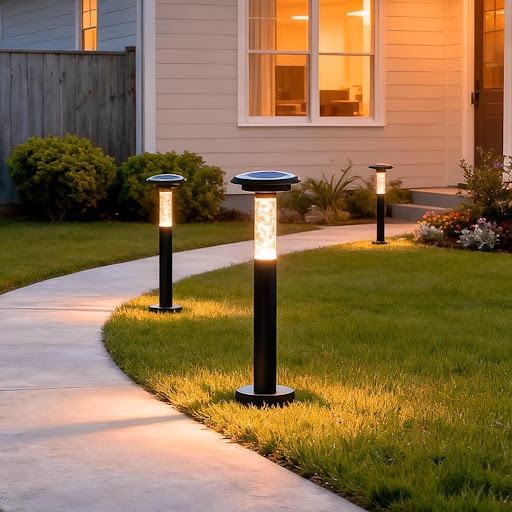
Carefully spaced solar fixtures can guide people along a walkway while using fewer lights.
Start With a Nighttime Walk Around the Property
Buying a large set before deciding where light is actually needed often leads to overlighting and unused fixtures. Instead, walk through the yard after dark with a flashlight. Notice changes in elevation, pathway curves, steps, gates, and areas where visitors may have difficulty seeing the route.
Prioritize functional locations first. Decorative lighting can be added later if needed. Mark the proposed positions with small flags and view them from the sidewalk, driveway, front door, and inside the house. This simple exercise helps determine whether each light serves a purpose or merely duplicates the fixture beside it.
Path lights should guide movement rather than create a continuous strip of intense brightness. Alternating fixtures from one side of a walkway to the other can produce a natural rhythm with fewer units. Wider beam patterns may also cover more ground than narrow decorative markers.
Give Every Solar Panel Access to Direct Sunlight
Many disappointing solar-lighting installations begin with a location problem rather than a product failure. A fixture may look attractive beneath a tree or beside a tall shrub, but its battery cannot store much energy if the panel remains shaded for most of the day.
Observe the yard several times because shadows move as the sun crosses the property. Roof overhangs, fences, trees, and dense plants can block light even when a location appears sunny during installation. Seasonal changes matter too. A bright spring location may become shaded when nearby trees develop a full canopy.
If a fixture receives insufficient sunlight, move it before assuming the battery is defective. Ground stakes make this easy, although they should be inserted into softened soil rather than forced into hard ground. Never push on the lamp head to drive a stake downward, since this can crack the housing or weaken the connection.
Select Path Lights for the Conditions You Actually Have
Not every yard requires the same type of fixture. A sheltered flower bed has different demands from a driveway edge exposed to sprinklers, wind, snow, and lawn equipment. The most suitable solar path lights should match the environment as well as the preferred appearance.
For soft planting beds, a sturdy ground stake allows flexible positioning. Near hardscaping, consider fixtures designed for surface mounting rather than improvising an unstable installation. In regions with snow, a taller fixture may remain more visible, but it must also be placed where shovels and snow removal equipment will not strike it.
Homeowners in hot, sunny climates should pay attention to materials that will be exposed to prolonged ultraviolet light. In wet areas, water resistance and drainage become especially important. No outdoor fixture should sit in a low spot where water regularly collects unless it is specifically designed for that condition.
Clean the Panel Before Replacing the Light
Dust, pollen, leaves, sprinkler residue, bird droppings, and wildfire smoke particles can reduce the amount of sunlight reaching a solar panel. A light may gradually become dimmer even though its LED and battery are still functioning.
Turn the fixture off if the manufacturer’s instructions recommend doing so, then wipe the panel with a soft, damp cloth. Avoid abrasive pads and harsh cleaners that might scratch or cloud the surface. Clean the shade at the same time so the available light can escape without being blocked by dirt.
How often this is necessary depends on local conditions. A fixture near a dusty road, sprinkler, or flowering tree may need attention more frequently than one in a protected yard. Adding the task to a seasonal outdoor-maintenance checklist is easier than waiting until every light stops working.
Check the Battery and Switch
Rechargeable batteries lose capacity with age. Shorter operating time does not automatically mean the whole fixture has reached the end of its life. First, confirm that the switch is on, remove any protective film from the panel, clean the contacts if permitted, and allow the light to charge in strong sunlight.
If performance remains poor, consult the instructions to determine whether the battery is replaceable. Use only the specified rechargeable battery type, voltage, and size. A disposable battery should not be substituted in a solar fixture designed to recharge its battery during the day.
Examine the battery for swelling, leakage, corrosion, or unusual heat. Stop using damaged batteries and keep them away from children, pets, heat, and combustible materials. Do not try to repair or puncture a battery.
Protect Fixtures During Yard Work and Severe Weather
Lawn mowers, string trimmers, rakes, and garden hoses can cause more damage than normal weather. Keep fixtures far enough from the edge of the lawn to avoid repeated impacts. If landscaping crews maintain the property, make the lights clearly visible or temporarily remove stake-mounted models before major work.
Check fixtures after storms and freeze-thaw cycles. Straighten leaning stakes, clear debris from panels, and confirm that water is not trapped inside the housing. Removable lights can be stored during extreme seasonal conditions if the manufacturer recommends it. Clean and dry them first, then keep them in a location where batteries will not be exposed to excessive heat or moisture.
Dispose of Batteries and Broken Fixtures Responsibly
Eventually, even a well-maintained light will reach the end of its usable life. Do not automatically place the entire fixture in a household recycling cart. Solar lights can combine metal, plastic, electronic components, LEDs, and rechargeable batteries, and local collection programs may handle these materials differently.
Remove the battery only when it is safe and the product instructions allow it. Protect exposed battery terminals as directed by the receiving program, and use a local battery, electronics, or household hazardous-waste collection option. Damaged lithium batteries require particular care and should never be placed in curbside trash or recycling, where they can create a fire risk during collection and processing.
Consult local disposal guidance before separating the remaining components. Recycling symbols on individual parts do not necessarily mean those items belong in a residential cart.
Use Less, Maintain More
Solar path lighting can support a lower-energy outdoor space, but long-term value comes from thoughtful ownership. Buy only the number of fixtures the property needs, place them where they can charge effectively, and choose designs that can be cleaned and serviced. Regular maintenance takes only a few minutes and may prevent an entire set from being replaced prematurely. The most sustainable light is often the one that continues doing its job season after season.