
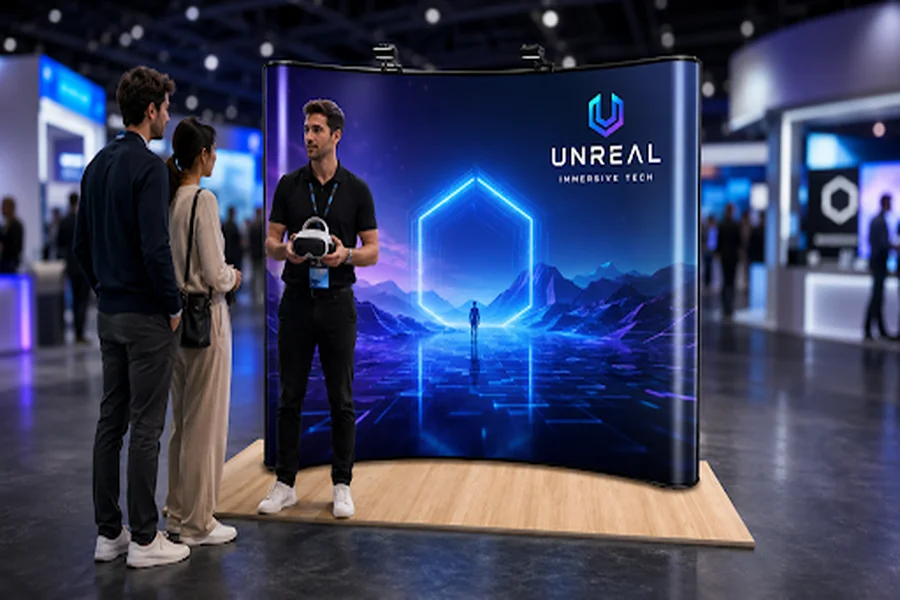
Two years ago, AR and VR at trade shows meant a six-figure line item like custom headsets, a development team, and a booth built around a single immersive centerpiece. That era is over.
What’s changed is accessibility. The tools that used to require a specialist now run on a tablet, a phone, or a $300 headset, which means immersive experiences are no longer reserved for the exhibitors with the biggest budget. They’re available to anyone willing to plan for them.
Here’s what’s actually exciting about that shift, and where it pays off on the show floor.
The Real Advantage Isn’t the Tech. It’s the Dwell Time.
The average attendee spends under a minute at most booths. Immersive experiences routinely double or triple that number, not because the technology is novel anymore, but because it gives visitors a reason to stay put while your team talks.
That’s the metric that matters. A longer dwell time means more conversation, more qualified conversation, and more attendees willing to hand over contact information in exchange for an experience they can’t get anywhere else on the floor.
Where AR Earns Its Keep
Augmented reality is the more budget-friendly of the two, and often the more practical for a 10×10 or 10×20 footprint, because it doesn’t require dedicated headset hardware or a private demo area.
Product visualization is the strongest use case. A tablet or phone camera pointed at a marker reveals a 3D rendering of a product too large, too expensive, or too abstract to bring to the show floor, industrial equipment, architectural builds, or configurable products with dozens of variants. Attendees see the full version of what you sell without you shipping a single crate of it.
AR business cards and signage are the cheapest entry point of all. A printed graphic with an embedded AR trigger turns a static banner into a short animated pitch the moment a phone camera passes over it. It costs almost nothing beyond the design work, and it turns your printed graphics, the ones already covering your booth into an interactive layer instead of a passive one.
Gamified AR scavenger hunts across a show floor or booth cluster drive foot traffic to your space rather than past it, particularly effective for exhibitors trying to overcome a less prominent aisle position.
Where VR Earns Its Keep
Virtual reality asks more of your footprint and your budget, but it delivers the deepest engagement on the floor and it’s the format most likely to get an attendee talking about your booth after the show ends.
Guided product walkthroughs work best for anything an attendee can’t physically experience in a booth: a facility tour, a vehicle interior, a job site, a surgical procedure, a construction process. One headset and one designated demo corner is enough. You don’t need six stations, you need one experience good enough that a line forms.
Training and simulation demos convert especially well for B2B and industrial exhibitors, because the experience doubles as proof of product capability. A VR demo of your equipment operating safely in a hazardous environment does more convincing than any spec sheet.
The budget-conscious approach: rent headsets for the show duration rather than purchasing, and build one strong VR experience rather than several thin ones. A single standout demo people talk about outperforms three mediocre ones nobody finishes.
The Setup That Makes or Breaks It
None of this works if the physical booth around it can’t support it. AR and VR demos need a defined, slightly enclosed space visually separated from the open walkway so attendees using a headset don’t feel exposed, and so the surrounding noise doesn’t break the immersion.
A canopy structure with clean sightlines and a partially closed side does that job well, giving you a demo corner without the cost of full walled construction. Options like a custom canopy tent canada can be printed and configured specifically to frame that kind of dedicated experience zone, keeping the immersive area visually distinct from your main product display.
Pair that with the surrounding graphic panels and signage, the layer most AR triggers actually live on and sourcing from a specialist in trade show displays canada ensures the print quality is sharp enough for camera recognition to work reliably, not just look good.
The Takeaway
AR and VR aren’t upgrades anymore. They’re accessible tools that reward the exhibitors willing to plan one focused experience instead of chasing every gimmick on the market. Pick one. Make it excellent. Build the booth around it.